When starting a fitness journey, the array of machines, weights, and complex routines available can be overwhelming. Fortunately, human bodies evolved to move without external resistance machines. Bodyweight training (calisthenics) utilizes your own mass to provide the resistance needed to stimulate muscle growth, improve joint stability, and increase endurance.
Why Start with Bodyweight Training?
Bodyweight exercises teach functional movement patterns. Before adding external loads like dumbbells or barbells, it is essential to understand how to control your own body in space. This develops a mind-muscle connection and strengthens stabilizing muscles that machines often ignore.
- Safety: Learning form without heavy weights significantly reduces injury risk.
- Convenience: You can train anywhere, at any time, instantly removing the "I don't have time for the gym" barrier.
- Scalability: Every bodyweight movement has regressions (easier versions) and progressions (harder versions).
The Fundamental Movements
1. The Bodyweight Squat
The squat is the king of lower-body movements, targeting the quadriceps, hamstrings, and glutes.
- Stance: Feet slightly wider than shoulder-width apart, toes pointed slightly outward.
- Descent: Push your hips back as if sitting in a chair. Keep your chest up and your heels flat on the floor.
- Depth: Aim to get your thighs parallel to the floor, but only go as deep as your mobility safely allows.
- Mistake to avoid: Letting the knees collapse inward. Actively push your knees out to track over your toes.
2. The Push-Up
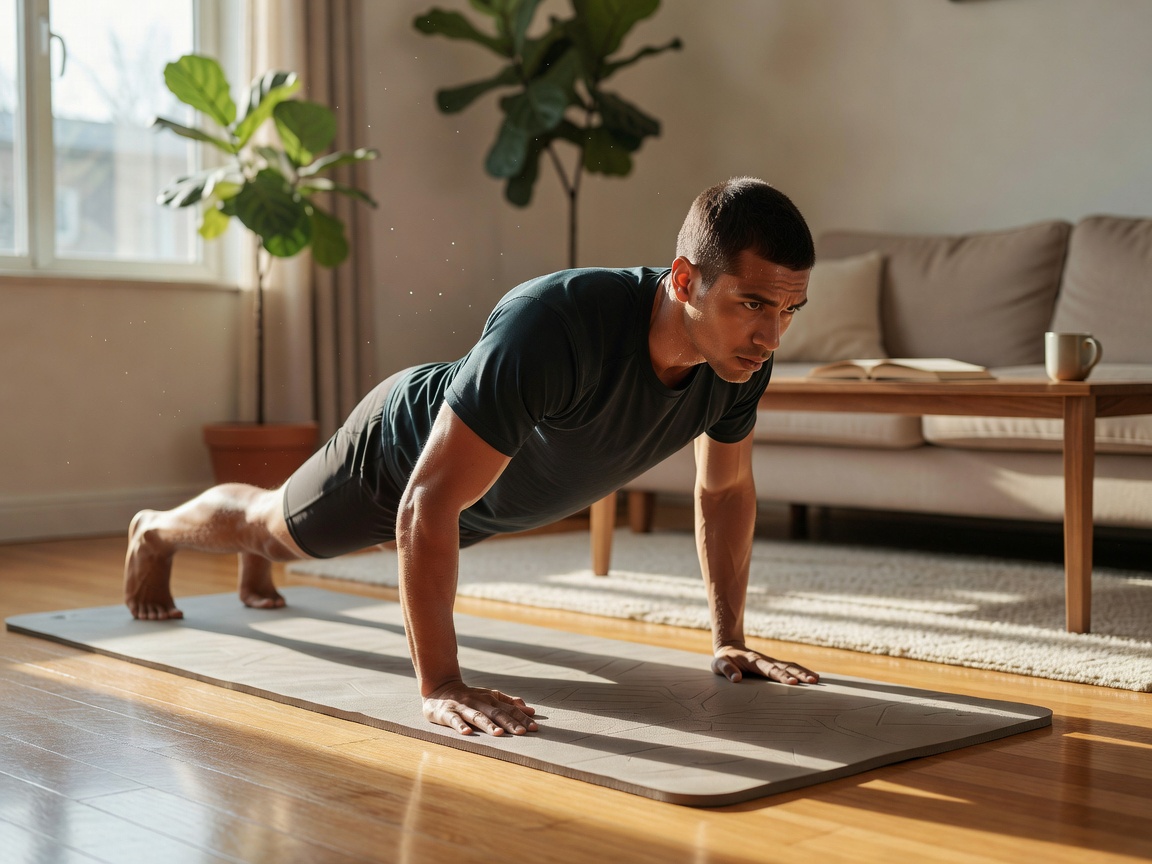
A fundamental upper-body pushing exercise that develops the chest, shoulders, triceps, and core.
- Setup: Hands positioned slightly wider than shoulder-width. Body in a straight line from head to heels (the plank position).
- Execution: Lower your body until your chest is an inch from the floor, keeping your elbows tucked at roughly a 45-degree angle to your torso.
- Modification: If standard push-ups are too difficult, perform them with your hands elevated on a sturdy chair or countertop (incline push-ups) rather than dropping to your knees, as inclines better train core stability.
3. The Reverse Lunge
Lunges improve balance, unilateral (single-leg) strength, and hip flexibility.
- Execution: Stand tall, step backward with one foot, and lower your hips until both knees are bent at a 90-degree angle. Push off the back foot to return to the start.
- Why reverse? Reverse lunges are generally gentler on the knees for beginners compared to forward lunges, as they make it easier to keep your weight shifted to your front heel.
Structuring Your First Routine
For beginners, a full-body routine performed 2-3 times a week yields excellent results. Avoid working out the same muscles on consecutive days; give your body 48 hours to recover and rebuild.
| Exercise | Sets | Reps | Rest Between Sets |
|---|---|---|---|
| Bodyweight Squats | 3 | 10-15 | 60 seconds |
| Incline or Standard Push-Ups | 3 | 5-10 | 60 seconds |
| Reverse Lunges | 3 | 8-12 per leg | 60 seconds |
| Plank Hold | 3 | 20-30 seconds | 60 seconds |
Consistency matters more than intensity in the beginning. Focus on executing each repetition slowly and with perfect form rather than rushing to complete the set. As these movements become easier, you can increase the repetitions, slow down the tempo, or move to more difficult variations.